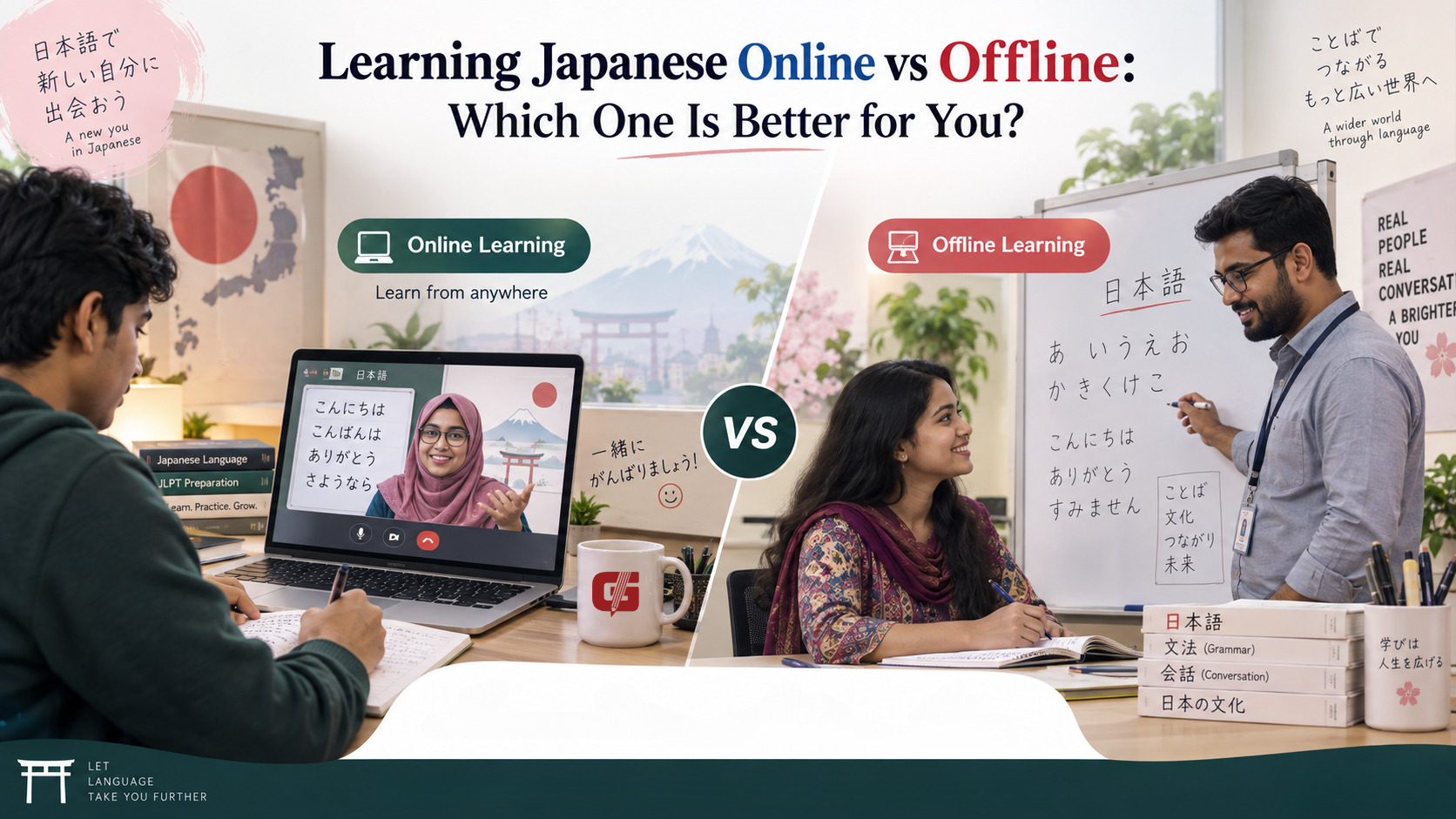
Learning Japanese has become increasingly popular among Bangladeshi students, especially those planning to study, work, or build a career in Japan. However, before enrolling in a Japanese language course, students often have many questions about the language, JLPT, course duration, learning difficulty, and future opportunities. Based on common questions students ask during counselling, here are some of the most frequently asked questions about Japanese language courses.
1. Is Japanese Difficult to Learn?
Japanese can seem difficult at first because it has three writing (MCQ) systems: Hiragana, Katakana, and Kanji. The grammar structure is also different from English and Bengali. However, Japanese is not impossible to learn. With proper guidance and regular practice, beginners can gradually build their skills. The key is consistency. Studying Japanese for a short time every day is generally more effective than studying for many hours only once a week.
2. How Long Does It Take to Learn Japanese?
The time required depends on the student's goal, study routine, learning method, and previous language-learning experience. A student studying consistently may build basic Japanese skills within several months. Reaching higher proficiency levels such as JLPT N3 or N2 requires considerably more time and practice. Students should therefore avoid expecting fluency within a few weeks. Japanese language learning is a gradual process.
3. What Is JLPT?
JLPT, or the Japanese-Language Proficiency Test, is one of the most well-known Japanese language proficiency examinations.
It has five levels:
- N5 – Beginner
- N4 – Basic
- N3 – Intermediate
- N2 – Upper-intermediate
- N1 – Advanced
N5 is the entry level, while N1 is the highest level.
Students often use JLPT as a way to measure their Japanese proficiency and set clear learning goals.
4. Which JLPT Level Should I Aim For Before Going to Japan?
There is no single answer for every student because the required level depends on the student's purpose. Someone going to Japan through a Japanese language school may have different requirements from someone entering a Japanese-taught university program or seeking professional employment. From a practical perspective, students should aim to build at least a basic foundation before travelling. Reaching a higher level can make everyday communication, study, and adaptation significantly easier.
5. Do I Need to Learn Japanese Before Going to Japan?
This is one of the most common questions students ask.
Technically, some international students can go to Japan without advanced Japanese, particularly when they are entering an English-taught program. However, learning Japanese before departure can provide a major advantage.
Even basic Japanese can help students with:
- Shopping
- Transportation
- Restaurants
- Asking for directions
- Communicating with local people
- Understanding university information
- Daily activities
- Part-time job communication
For students planning to attend a Japanese language school, starting Japanese before travelling can also make the transition smoother.
6. Can I Study in Japan Without Knowing Japanese?
Yes, depending on the program and institution.
Japan has English-taught academic programs, particularly at the university level. However, students should understand that academic language requirements and everyday communication are two different things.
Even if a student's academic program is taught in English, Japanese can still be extremely useful outside the classroom.
This is why I generally encourage students going to Japan to learn at least some basic Japanese before departure.
7. Should I Learn Japanese in Bangladesh or in Japan?
Both options have advantages.
Learning in Bangladesh before travelling can help students establish their foundation at a lower cost and arrive in Japan with some confidence. Learning in Japan provides an immersive environment where students can practice Japanese in real-life situations every day.
For many students, the best approach can be:
Learn the basics in Bangladesh → Continue improving in Japan → Practise Japanese in real-life situations
8. What Will I Learn in a Japanese Language Course?
A properly structured Japanese language course should cover the major language skills, including:
- Hiragana
- Katakana
- Kanji
- Vocabulary
- Grammar
- Listening
- Speaking
- Reading
- Writing
- Conversation
A good course should not focus only on memorizing words or grammar rules. Students should also get opportunities to use Japanese in practical situations.
9. When Should I Start Learning Kanji?
Kanji is an important part of Japanese, but beginners should not become overwhelmed by it. Students normally start with basic Kanji after developing a foundation in Hiragana and Katakana. The best approach is to learn Kanji gradually and connect each character with vocabulary and example sentences rather than simply memorizing a long list.
10. Is Speaking Japanese More Important Than Writing?
Both are important, but the priority depends on the student's goal.
For students preparing to live in Japan, speaking and listening are particularly important for everyday communication. At the same time, reading and writing become increasingly important for education, examinations, documents, and professional environments. Therefore, students should aim to develop all four skills rather than focusing exclusively on one.
11. Which Books Should I Use to Learn Japanese?
The right book depends on the learner's level and objective.
Popular Japanese learning resources include textbooks such as Minna no Nihongo, Genki, and other structured Japanese-language textbooks. For JLPT preparation, students should use materials specifically designed around their target level. However, a textbook alone is not enough. Students should combine their books with listening practice, speaking practice, vocabulary review, and real-life Japanese exposure.
12. Can I Learn Japanese Through YouTube and Apps?
Yes, online resources can be very useful.
YouTube, language-learning apps, flashcards, listening materials, and online dictionaries can support Japanese learning. However, many beginners struggle because they use too many resources without following a structured learning plan.
A better approach is:
One structured course + one main textbook + regular listening + speaking practice + vocabulary revision
This provides structure while still allowing students to use digital resources.
13. How Much Time Should I Study Japanese Every Day?
There is no universal number of hours that guarantees success.
For a busy student, even 30–60 minutes of focused daily practice can be valuable if done consistently.
A simple routine could include:
15 minutes: Vocabulary
15 minutes: Grammar
15 minutes: Listening
15 minutes: Speaking or reading
Students with more time can increase these sessions gradually.
Consistency matters more than studying for several hours occasionally.
14. Can Learning Japanese Help My Career?
Yes. Japanese can be a valuable additional skill, particularly when combined with another professional qualification.
For example:
Japanese + IT
Japanese + Engineering
Japanese + Business
Japanese + Hospitality
Japanese + Healthcare
The combination of language ability and professional expertise can create opportunities in both Bangladesh and Japan.
15. Is Japanese Useful for Part-Time Jobs in Japan?
Japanese ability can be important when communicating with employers, colleagues, and customers.
The level of Japanese required depends heavily on the type of job. Jobs involving frequent communication with Japanese customers or staff may require stronger Japanese skills.
Therefore, students should not think of Japanese simply as an examination subject. It can also be a practical communication skill.
16. What Is the Biggest Mistake Students Make When Learning Japanese?
One of the biggest mistakes is expecting quick results.
Some students memorize vocabulary for a few weeks and then stop practising. Others focus heavily on JLPT questions without developing practical communication skills.
Another common mistake is trying to learn everything at once.
Japanese should be learned step by step:
Hiragana & Katakana → Basic Grammar → Vocabulary → Kanji → Conversation → JLPT Preparation → Higher-Level Japanese
17. What Should I Look for When Choosing a Japanese Language Course?
Before enrolling, students should consider:
- Teacher qualifications
- Course structure
- Class size
- Course duration
- Study materials
- Speaking practice
- Listening practice
- JLPT preparation
- Mock tests
- Student support
- Class schedule
- Overall cost
Don't choose a course only because it is cheap or advertised as a "fast Japanese course."
Instead, look at what the course will actually teach and whether it matches your goal.
18. Should I Take a Japanese Language Course If My University Program Is in English?
Yes, in many cases it can still be beneficial.
Your academic classes may be conducted in English, but daily life in Japan involves communication outside the classroom. Learning Japanese can help you communicate with local people, understand signs and instructions, manage everyday tasks, and become more comfortable in Japanese society.
It can also provide an additional skill that may be useful for future career opportunities.
The most important thing students should understand is that learning Japanese is not simply about passing the JLPT. It is about developing a practical communication skill that can support your education, daily life, cultural understanding, and career goals. If you are planning to study or work in Japan, starting Japanese early can give you a valuable advantage. You do not need to become fluent immediately. Start with the basics, build a strong foundation, practice consistently, and gradually work toward your target JLPT level. The best time to start learning Japanese is before you need it.